
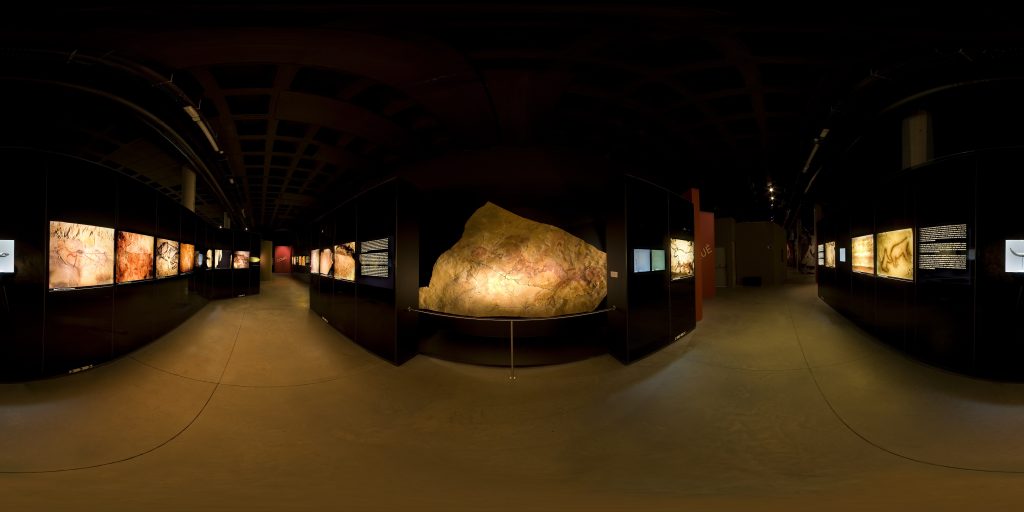
Con esta primera interrogante mostramos la representación artística dividida en dos tipos: figura naturalista y signos.
Por un lado en la primera parte de este pasillo, a ambos lados, tenemos la Figura animal -principalmente mamíferos herbívoros- siendo los más frecuentes caballos y bisontes, seguidos por cabras, ciervos, algunos mamíferos ya extintos como el mamut, el uro (una especie de toro prehistórico) o el megacero (un cérvido de gran cornamenta).
A continuación, y menos frecuente es la representación de otro tipo de fauna, como los animales peligrosos o los animales marinos, y casi anecdótico el recuento de aves o insectos.
Mit der Antwort auf diese erste Frage zeigen wir die in zwei Typen aufgeteilten künstlerischen Darstellungen: naturalistische Figuren und Zeichen.
Zum einen finden wir im ersten Teil dieses Gangs zu beiden Seiten Tierfiguren –hauptsächlich pflanzenfressende Säugetiere. Die häufigsten unter ihnen sind Pferde und Bisons, gefolgt von Ziegen, Hirschen, einigen bereits ausgestorbenen Säugetieren wie dem Mammut, dem Auerochsen (eine Art prähistorischer Stier) oder dem Riesenhirsch (ein Hirsch mit großem Geweih).
Anschließend sehen wir die weniger häufig anzutreffenden Darstellungen von gefährlichen Tieren oder Meerestieren und die nur in geringer Anzahl auftauchenden Abbildungen von Vögeln oder Insekten.
Pour répondre à cette première question, la représentation artistique est divisée en deux types : la forme naturaliste et les signes.
Tout d’abord, dans la première partie du couloir, des deux côtés, la forme animale – représentant surtout des mammifères herbivores – : les plus fréquents sont les chevaux et les bisons, suivis par les chèvres, certains mammifères déjà disparus, comme le mammouth, l’aurochs (une sorte de taureau préhistorique) ou encore le mégacéros (un cervidé aux bois immenses).
Le deuxième type de représentation, moins fréquent, concerne les animaux dangereux ou les animaux marins. Quant aux oiseaux ou aux insectes, ils sont à peine représentés.
With this first question, we show the artistic representation divided into two types: naturalistic figures and symbols.
On both sides of the first section of this hall we find the animal figure, made up primarily of herbivorous mammals. The most popular animals include horses and bison, followed by goats, deer, and other now-extinct mammals like the mammoth, the aurochs (a kind of prehistoric bull which is now extinct) and the Irish Elk (a giant deer with large antlers).
Further on, we find other kinds of fauna which occur much less frequently. There are dangerous animals as well as marine animals and the almost anecdotal appearance of birds and insects.
Con esta primera pregunta amuésase la representación artística estremada en dos tipos: figura naturalista y signos.
D’un llau, na primer parte d’esti pasillu, a entrambos llaos, tenemos la Figura animal -sobre too mamíferos, herbívoros- siendo los más frecuentes caballos y bisontes, siguíos por cabres, venaos, dellos mamíferos yá desaniciaos como’l mamut, l’uru (una especie de güe prehistóricu) o’l megaceru (un cérvidu de cuerna pergrande).
De siguío, y menos frecuente, ye la representación d’otra clas de fauna, como los animales peligrosos o los animales marinos, y cuasi anecdóticu ye’l recuentu d’aves o insectos.